Under-ventilating a poultry house costs money in ways that do not show up on the electricity bill: birds go off feed above roughly 30 °C, ammonia accumulation damages respiratory tracts, and damp litter raises disease pressure and labour cost.
Over-ventilating costs money too — in fan capital, running load and winter heating. This guide covers the two standard sizing methods and works through a real broiler house end to end.
Method 1 — Air changes per hour (ACH)
The simplest approach. Calculate the internal volume of the shed and multiply by the air changes per hour the application requires.
Required airflow (m³/h) = Length (m) × Width (m) × Height (m) × ACH
Typical ACH targets: 60 for hot-weather broiler housing, 40–50 for layer houses, 30–40 for general livestock, 6–15 for warehouses and 15–30 for industrial workshops. Hot-weather poultry sits at the top of the range because ventilation is doing heat removal, not just air quality.
Method 2 — Tunnel velocity (better for hot-weather broiler housing)
For tunnel-ventilated houses in hot weather, target air velocity rather than air changes. Moving air across the birds produces a wind-chill effect that ACH alone does not capture.
Required airflow (m³/h) = Cross-sectional area (m²) × Target velocity (m/s) × 3600
Target tunnel velocity is typically 2.0–2.5 m/s for broilers in peak heat, and 1.5–2.0 m/s for layers. Cross-sectional area is width × average height of the house.
Where the two methods disagree, use whichever gives the larger number — then confirm against your bird density and local climate.
Worked example: a 100 m × 12 m broiler house
House: 100 m long, 12 m wide, 3 m average clear height. Tunnel-ventilated, hot-weather design condition.
ACH method: 100 × 12 × 3 = 3,600 m³ volume. At 60 ACH, required airflow = 216,000 m³/h.
Tunnel velocity method: cross-section = 12 × 3 = 36 m². At 2.0 m/s, required airflow = 36 × 2.0 × 3600 = 259,200 m³/h.
The tunnel method is larger, so we design to 259,200 m³/h.
| Option | Model | Airflow each | Fans needed | Total airflow | Total power |
|---|---|---|---|---|---|
| A | Ayzair-1750 | 68,000 m³/h | 4 | 272,000 m³/h | 6.0 kW |
| B | Ayzair-1530 | 57,000 m³/h | 5 | 285,000 m³/h | 6.0 kW |
| C | Ayzair-1380 | 44,500 m³/h | 6 | 267,000 m³/h | 6.6 kW |
← Swipe the table sideways to see all columns
Choosing between the options
- Fewer, larger fans mean fewer wall penetrations, less structural framing and simpler wiring — usually the lower installed cost.
- More, smaller fans give finer staging control: you can run two of six in mild weather instead of one of four, which matches ventilation to actual demand more precisely and saves energy across the year.
- Best practice on a long house is a mix: size the bank for peak summer with the largest model, and add two smaller fans for minimum-ventilation staging in cool weather.
- Always allow for one fan out of service. A bank of six with one down loses 17% of capacity; a bank of four loses 25%.
Inlet area — the mistake that wastes fan capacity
Exhaust fans can only move the air the inlets let in. If inlet free area is undersized, static pressure rises, fan output collapses below its rated figure, and you have paid for capacity you will never see.
As a working rule, provide at least 1 m² of inlet free area for every 10,000–12,000 m³/h of installed exhaust capacity. For the 259,200 m³/h example above, that means roughly 22–26 m² of inlet free area — typically evaporative cooling pads across the inlet gable, which also delivers the temperature drop.
Remember that a louvre or pad has a free-area factor well below its gross dimension. Use the manufacturer free-area figure, not the frame size.
Why the shutter type matters in poultry
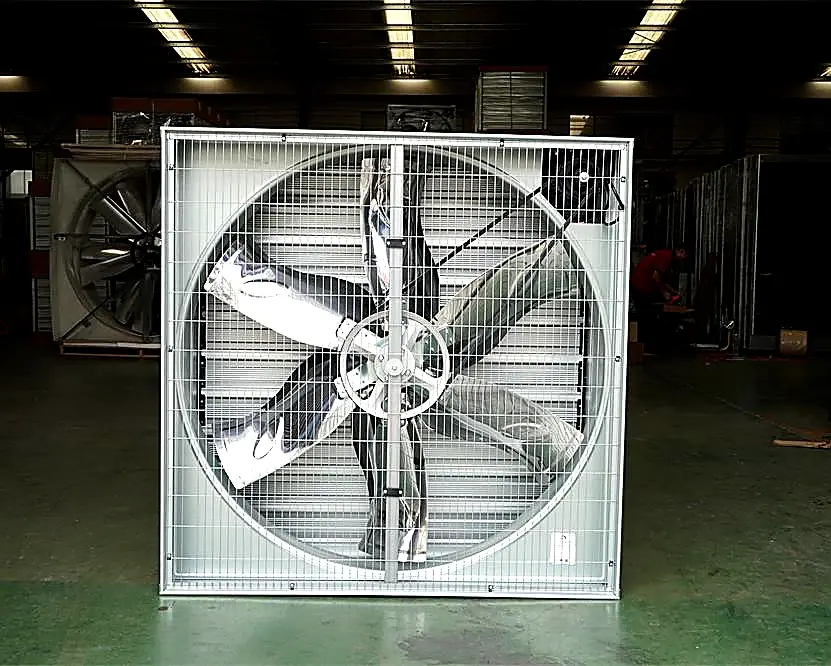
A gravity drop-hammer shutter has no motor and no actuator: airflow pushes the aluminium louvres open, gravity drops them shut when the fan stops. There is nothing to burn out, which matters in a building where fans stage on and off dozens of times a day for years.
When closed, the louvres block reverse airflow, wind-driven rain, dust and pest entry — important both for biosecurity and for maintaining a controlled pressure profile when only part of the bank is running.
Send your shed dimensions
Give us length, width, height, bird type and location. We will return a complete fan schedule with staging, inlet area and connected load at no cost.
Request a ventilation design